The Totem Paradox : Republican Promise vs. Daily Extortion
At seven in the morning at a service station on the outskirts of Bastia or high in the mountains of Corte, an independent contractor watches the numbers roll on the pump display: 60 liters of diesel, €122. For island households forced to travel dozens of kilometers daily over mountainous terrain with no viable passenger rail alternatives, fuel expenditure has turned into a crippling economic drain.
Yet, on the statute books of the French Republic, an entirely different reality is promised:
Under Article 297 of the French Tax Code (CGI), Corsica is granted a reduced 13% VAT rate on petroleum products (against 20% on the mainland) alongside a TICPE excise rebate. Under pure tax arithmetic, pump fuel should cost between 8 and 12 euro cents less than in Marseille or Toulon.
In actual practice, fuel costs 10 to 25 cents more. The state-subsidized tax break is systematically intercepted at the tanker manifold by a logistics cartel that extracts €48 million per year in pure monopolistic rent, without any government intervention in nearly four decades.
This silent heist is not an accident of geography: it is the direct outcome of an airtight contractual monopoly, dissected in forensic detail by competition authorities and citizen watchdogs.
Two Pipelines for an Entire Island : The Logistical Bottleneck of Lucciana and Vazzio
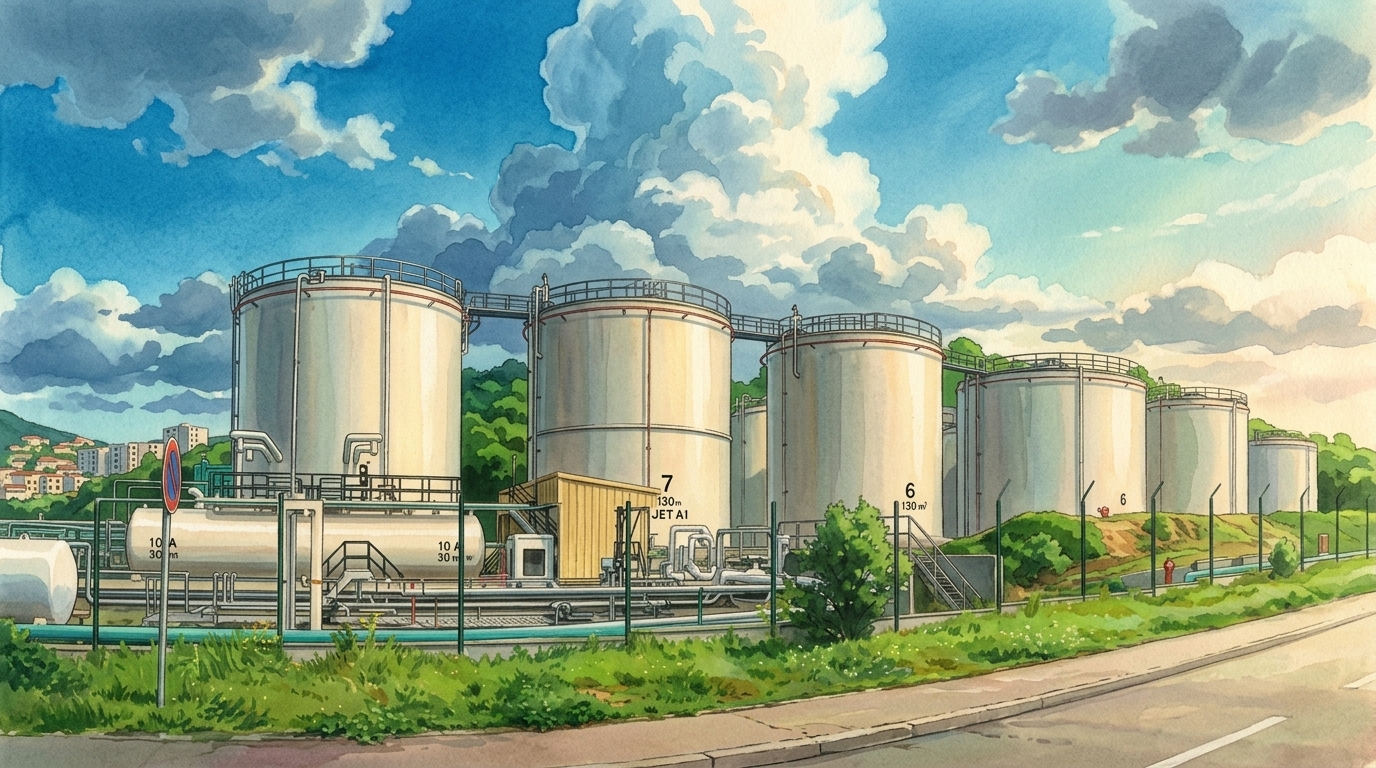
To understand how a handful of multinationals managed to capture Corsica’s entire energy market, one must first look at the map. The island possesses no refinery. Every drop of gasoline, diesel, and aviation fuel must be refined on the southern French mainland—primarily at Fos-sur-Mer and Lavéra—before crossing the Mediterranean aboard dedicated coastal tankers.
When these tankers arrive off Corsican shores, they cannot dock at commercial passenger quays. Hazardous petroleum cargo must be pumped through submerged offshore pipelines directly into heavy-duty storage tanks. Across the entire island, there are only two physical intake terminals:
- In the north, Lucciana Terminal (Haute-Corse), located at Pineto (
42.5432° N, 9.4444° E), hooked up to a submarine coastal mooring line. - In the south, Vazzio Terminal (Corse-du-Sud), overlooking the Gulf of Ajaccio (
41.9360° N, 8.7610° E), fed directly from the Saint-Joseph marine jetty.
Together, these two facilities account for an aggregate capacity of 85,000 cubic meters, funneling the 400 million liters of fuel required annually to keep Corsica running.
In its landmark ruling of November 17, 2025, the French Competition Authority stated at paragraph 32: these installations constitute an « essential facility that cannot be duplicated under reasonable economic conditions ». Constructing a third terminal would require tens of millions of euros in capital expenditure and insurmountable coastal zoning hurdles. The masters of Lucciana and Vazzio knew this well: by controlling the only two spigots, they held the entire island’s economic lifeline in their grip.
The Cartel Unmasked : The Shockwave of the €187.5 Million Fine
For decades, any complaint regarding Corsican fuel prices was met with the same corporate script: « Island logistics are costly, maritime freight is unpredictable, and volumes are low. » On November 17, 2025, that narrative shattered under the weight of an unprecedented antitrust ruling.
Following years of undercover investigations, dawn raids, and forensic audits of financial transactions, the French Competition Authority published its 80-page Decision No. 25-D-07. Its conclusion was devastating: the joint operating company, SAS Dépôts Pétroliers de la Corse (DPLC), was not a neutral logistical facility. It was weaponized as the institutional shield of an unlawful cartel designed to exclude outside competitors, violating Article L. 420-1 of the French Commercial Code and Article 101 of the Treaty on the Functioning of the European Union.
The financial penalties ordered under Article 2 struck the corporate headquarters in Paris and London:
| Sanctioned Oil Major | Corporate Entities Penalized | Fine Imposed |
|---|---|---|
| TotalEnergies | TotalEnergies Marketing France & TotalEnergies SE | €115,820,000 |
| Rubis / ViTO Group | Rubis Énergie & Rubis SCA | €64,240,000 |
| EG Retail France | EG Retail France SAS & EG Group Limited | €7,000,000 |
| Tepsa France | Tepsa France SAS (formerly Rubis Terminal) | €430,000 |
| Total Fines Imposed | €187,490,000 | |
€187.5 million in fines. To grasp the magnitude of the punishment, DPLC’s own annual operating turnover is only a few million euros: the sanction targeted the global parent companies for organizing a captive island market. Furthermore, the court ordered the cartel to pay for a front-page legal notice printed in bold across regional daily Corse-Matin.
The Mechanics of Exclusion : Four Clauses of the Secret Master Agreement
How did this cartel operate for years in plain sight? Unsealing the 80-page antitrust file and confidential evidence logs exposes four contractual mechanisms of extraordinary sophistication.
The core apparatus was the Joint Storage Agreement (Contrat de Compte-Courant Matière - CCM) signed on March 22, 2016. Because fuel shipments from different companies are co-mingled inside DPLC tanks, the cartel introduced an astonishing legal fiction under Article 5.1: the lead manager of the terminal—Rubis Énergie, parent company of the ViTO retail chain—becomes the sole legal owner of 100% of all fuel stored across Corsica. From the marine manifold down to the loading gantry, every drop belongs legally to the cartel.
From this foundation, three exclusion mechanisms were implemented:
First, the artificial double-margin scheme (paragraphs 106 to 108). When a station belonging to a cartel shareholder (ViTO or TotalEnergies) draws fuel from the rack, it receives the product at net logistical cost, incurring only a single retail markup. But when an independent local distributor—such as the Ferrandi group under Esso branding—draws fuel, it faces a double toll:
- In an initial mandatory transaction (Transfer 1), the cartel shareholder sells the fuel at the rack while pocketing a wholesale markup and a “stock risk fee” (evidence files 4581-4582).
- The independent dealer must then apply its own operating margin (Transfer 2) to survive. The independent retailer arrives at the pump crippled by an artificial wholesale penalty, rendering competitive pricing impossible.
Second, the 12-month quota lock (paragraphs 54-55 and 128-131). During the summer tourism spike, terminals operate under tight inventory. The cartel routinely enforces quota rationing. However, withdrawal rights are calculated strictly on the volume removed over the preceding twelve months. If an independent dealer switches to an alternative mainland supplier offering better rates, its historical quota remains attached to its former supplier! The new entrant is allocated a zero quota, triggering catastrophic station stockouts within 48 hours.
Third, the elimination of regional entrants (paragraphs 67 and 254-255). In November and December 2009, Corsican independent group UCC (uniting local fuel families Ferrandi and Ceccaldi) formally offered to purchase Esso’s equity stake in DPLC. Their objective was straightforward: secure direct terminal access to charter their own tankers from Fos and lower island prices. The cartel’s response was immediate: a flat veto. While internal restructuring between multinationals (codenamed “Oracle” for Rubis/Shell and “Laetitia” for Total) was approved instantly, local Corsican entrepreneurs were systematically barred from owning storage tanks.
The Hidden Extraction : Airport Jet A-1 Fuel and the Annex 3 Markups
Antitrust evidence reveals an even deeper secret: the depot cartel did not limit its grip to road transport. It established total dominion over Corsica’s commercial airports.
Antitrust investigators uncovered a clandestine territorial division of aviation jet fuel (Jet A-1), formalized at paragraph 44:
« The distribution of jet fuel has, for its part, always been operated by two players, BP for the airports of Bastia, Ajaccio, and Calvi, and TEMC for the airport of Figari. »
Aircraft refueling at Bastia-Poretta, Ajaccio-Napoléon Bonaparte, and Calvi-Sainte-Catherine was 100% monopolized by BP France (via EG Retail and hauler Ferrandi). Figari-Sud Corse airport was reserved exclusively for TotalEnergies.
Here lies the most glaring insider privilege (paragraphs 79-80, files 2608 to 2624): while local fuel retailers were locked out of depots because they were not DPLC shareholders, BP received an occult carve-out. Despite having sold all its shares in DPLC in 2011, BP retained unrestricted access to Lucciana and Vazzio tanks through a private “sui generis” contract renewed by tacit agreement!
When interrogated under official deposition, corporate executives delivered devastating admissions:
- Rubis Terminal executive management conceded it was « a discrepancy between the contract and actual practice » (files 3876-3877).
- TotalEnergies management testified under oath that it « had no knowledge of how BP was granted the exact same facilities without being an enrolled shareholder » (file 2077).
This airport duopoly extracted immense sums from regional public finances. Airlines operating under the subsidized Public Service Delegation (Air Corsica and Air France) had no choice but to purchase jet fuel under this artificial duopoly, passing the inflated bill directly into the public subsidies paid by the Collectivité de Corse.
To seal the system, cartel members added Annex 3 to the master agreement (paragraph 52), establishing a mandatory schedule of flat fees for marine pumping, fuel additivation, and fiscal coloration (injecting chemical tracers to produce agricultural diesel or heating oil). Uncorrelated with verified maintenance costs, these flat markups generated a guaranteed private toll on every cubic meter exiting the terminals.
The Missing Biofuel Scandal : The Hidden Penalty on Gasoline Engines
Among the daily frustrations of island motorists, one question stands out: why is it completely impossible to purchase SP95-E10 anywhere in Corsica?
On the French mainland, SP95-E10 (containing up to 10% bioethanol) dominates the market: it is cheaper, cleaner, and carries lower excise duties. In Corsica, not a single station carries it.
The cause was documented by the Competition Authority in Opinion No. 20-A-11 (paragraphs 106 to 114) and submitted to the Conseil d’État: Bioethanol cannot be transported pre-blended across the sea without phase separation risks caused by marine moisture. Distributing E10 requires dedicated pure ethanol storage tanks at Lucciana and Vazzio to perform automated inline blending at the rack. However, DPLC cartel shareholders consistently refused to invest in ethanol storage tanks.
The financial penalty on island households is immediate:
- Deprived of E10, all Corsican gasoline drivers must buy standard SP95 or premium SP98.
- The retail price spread between Corsican standard SP95 and mainland SP95-E10 reaches 20 to 25 euro cents per liter.
- On a 50-liter fill-up, every island driver pays an extra €10 to €12.50, simply because the oil majors refused to install an ethanol tank.
Thirty-Seven Years of State Inaction : The Autopsy of Regulatory Failure
While corporate greed is unremarkable, the truly scandalous dimension of this case is the posture of the French State: a documented, prolonged, and culpable abdication of regulatory duty spanning nearly four decades.
Central ministries cannot plead ignorance:
- As early as 1989, the Competition Council (Decision 89-D-14) warned against terminal monopolization in Corsica.
- In 2018, a scathing report by the General Inspectorate of Finance (IGF No. 2018-M-072-03) proved that maritime freight surcharges were only 1.5 to 2.5 euro cents per liter, and that tax breaks were being captured by distributors.
- In 2020, formal Opinion 20-A-11 reiterated the total absence of competition on the island.
Confronting this bureaucratic paralysis, civic association A4C (Agir contre la cherté des carburants en Corse), led by Frédéric Poletti and represented by Supreme Court attorney Emmanuel Piwnica, filed a formal lawsuit before the Conseil d’État on February 20, 2026.
The legal filing entered two official records proving gross state negligence:
- Ministerial Admission of May 7, 2021 (Exhibit No. 7) : In an official letter to A4C, the Minister of Economy admitted that tax rebates were not reaching Corsican consumers and promised a joint economic mission (CGE/CGEDD) to evaluate price regulation under Article L. 410-2 of the Commercial Code. Result : five years of burial. Zero reports released, zero decrees signed.
- Prefectural Admission of November 30, 2018 (Exhibit No. 8) : The Prefect of Corsica confirmed that the reduced VAT rate represented a tax loss of €28 million per year for the State, captured entirely by oil companies.
Over nearly a decade, successive finance ministers watched over €220 million in public tax subsidies siphon directly into corporate profits without once enacting price controls!
The double standard becomes undeniable when looking across the Atlantic. Under Decree No. 2013-1314 of December 27, 2013, the French State strictly regulates fuel prices in Guadeloupe, Martinique, French Guiana, and Réunion, capping wholesale and retail margins monthly. Why is a legal framework that has protected French overseas citizens for thirteen years flatly denied to Corsican citizens?
The Empirical Proof : 191,000 Citizen Logs Disclose the Asymmetric Spread
While government offices remained silent, citizens conducted the forensic audit that public administrations refused to undertake. Under the leadership of A4C, a network monitored pump displays across 384 service stations between Corsica and the mainland, compiling an empirical database of 191,000 daily observations.
Statistical analysis of this data exposed an economic phenomenon known as the rocket and feather effect:
During the 111 crude price increases at Rotterdam in 2025, Corsican pump prices rose moderately (+1.65 c€/L vs. +2.96 c€/L on the mainland). This was no act of corporate goodwill: it demonstrated that island majors operated with such massive pre-existing profit margins that they could easily absorb global shocks without altering wholesale profitability.
Conversely, during the 170 crude price drops, the trap snapped shut: when world oil dropped by 5 cents, mainland prices fell by 3.7 cents, but Corsica surrendered only 1.9 cents. In 73% of cases, the price gap between Corsica and the mainland widened during global market downturns!
This price rigidity is the hallmark of monopoly: out of 1,000 station observations, diesel prices were adjusted only 74 times in Corsica, compared to 274 times on the mainland. With no alternative terminals, island motorists experience wholesale increases immediately, but never benefit from international market drops.
The Secret War in Commercial Court : Admitted Profits and Sealed Audits
While Corsican motorists struggled at the pump, the two cartel bosses engaged in a vicious commercial court battle behind closed doors.
Filings obtained from the Marseille Economic Activities Court (TAE) reveal that ViTO Corse (Rubis subsidiary) sued TotalEnergies (Docket No. RG 2023F00710), demanding €7,532,224 in damages for “unfair competition.”
The dispute erupted over Total’s 20-cent nation-wide rebate in late 2022. Fearing the loss of 30% of its market share in days, ViTO had to slash pump prices. The unsealed ruling of January 20, 2026 exposed genuine corporate profits:
- In 2022, forced to lower margins, ViTO Corse recorded a net operating loss of -€897,232.
- Over the exact same period, TotalEnergies Marketing Corse posted a historic record profit of +€3,926,326 (+17%)!
In dismissing ViTO’s lawsuit, the Marseille judges noted that Total’s normal gross margins in Corsica were so large that the company could absorb a 20-cent rebate without selling below cost!
Even more revealing, on May 9, 2023, the court placed economic expert Stéphane Meindl’s margin analysis under trade secrecy laws (Article L. 151-1 of the Commercial Code). Verified depot profit margins are locked away in judicial vaults to protect shareholder returns.
The cynicism reached its peak when ViTO management publicly threatened station closures and 400 layoffs on the island following the antitrust ruling. While its regional subsidiaries weaponized employment threats, parent company Rubis SCA reported on September 8, 2026 a half-year net profit of €191 million (+17%) on revenues exceeding €4 billion. Monopolistic rents extracted from Corsican drivers directly funded Parisian shareholder payouts.
Quantifying the Island Extraction and the Strategic Public Roadmap
The forensic quantification of this systemic extraction is now conclusively established:
Over a decade, nearly half a billion euros has been extracted from Corsican households and local contractors through an exclusionary logistics pact.
Civic resignation is no longer an option. The antitrust ruling of November 17, 2025 and the pending lawsuit before the Conseil d’État provide the legal foundation to reclaim the depots for the public good through four immediate actions:
- Immediate Price Regulation Under Commercial Code Article L. 410-2 : The Prime Minister and Minister of Economy must end their culpable inaction and enact a decree extending the overseas regulatory framework to Corsica: setting monthly ceiling prices and capping wholesale and retail margins.
- Reclassifying Depots Under Regulated Third-Party Access (rTPA) : DPLC’s closed shop must end. Lucciana and Vazzio must be declared “strategic public infrastructures,” legally mandating non-discriminatory terminal access for any third-party fuel distributor under tariffs audited by the Energy Regulatory Commission (CRE).
- Mandatory Ethanol Tanks for SP95-E10 Distribution : Mandate terminal operators by prefectural order to install pure ethanol blending tanks, making SP95-E10 available across all island stations and returning 20 euro cents per liter to motorists.
- Creation of a Strategic Territorial Energy Reserve : A majority equity acquisition by the Collectivité de Corse in bulk terminal infrastructure, securing a 60-day territorial fuel buffer to eliminate threats of maritime supply blackmail.
Citizen FOI Action Guide : Key Public Records to Requisition
To enforce total transparency, any citizen, elected representative, or civic association has the legal right under the French Code of Relations between the Public and Administration (CRPA, Art. L. 311-1) and the Environmental Code (Art. L. 124-1) to demand immediate disclosure of key public documents:
🎯 Strategic Documents to Requisition :
| Custodian Public Body | Specific Document to Requisition | Statutory Ground & Direct Link |
|---|---|---|
| Prefecture of Corse-du-Sud & DREAL | Prefectural Order n° 2A-2021-04-29-0006 of April 29, 2021 (Operating licenses for DPLC Vazzio terminal, lower-tier SEVESO) and annual inspection audits | Géorisques Vazzio / Art. L. 124-1 C. Env. |
| Haute-Corse Prefecture & DREAL | Prefectural Order n° 2B-2022-06-21-00006 of June 21, 2022 (Operating safety rules for DPLC Lucciana terminal, Pineto, lower-tier SEVESO) | Géorisques Lucciana / Art. L. 124-1 C. Env. |
| Corsica Chamber of Commerce (CCI) / Airports | Jet A-1 Fuel Supply Concessions & Airport Refueling Sub-concession Agreements (Bastia, Ajaccio, Calvi, and Figari airports - BP and TEMC contracts) | OpenData corse.cci.fr / Art. L. 311-1 CRPA |
| Collectivité de Corse (Assembly) | Deliberations n° 18/422 AC, 21/087 AC, and 21/172 AC regarding fuel prices, social summits, and regional distribution audits | OpenData isula.corsica / Art. L. 2121-26 CGCT |
| Ministry of Economy & Finance / IGF | IGF Report n° 2018-M-072-03 (“For a 21st Century Corsican Economy”, maritime freight surcharges, wholesale margins) | IGF Public Archives / Art. L. 311-1 CRPA |
| Bercy / Fraud Directorate (DGCCRF) | Regional audit reports on verified refining and retail fuel margins across Corsica since 2020 | Art. L. 311-1 CRPA (Formal CADA Request) |
📊 Forensic Audit Matrix : The Corsican Fuel Bottleneck
| Investigation Vector | Officially Established Finding | Judicial Reference & Source | Forensic Assessment |
|---|---|---|---|
| Antitrust Fine | €187.49 Million in Penalties | Competition Authority (Decision 25-D-07) | 🔴 Formal Criminal & Civil Sanctions |
| Terminal Bottleneck | 85,000 m³ controlled by DPLC (Lucciana/Vazzio) | DREAL Corsica / ICPE Registries | 🔴 Non-Replicable Essential Facility |
| Annual Island Fuel Volume | 400 Million Liters | DGEC / Regional Energy Balance | ⚠️ Total Captive Market |
| Annual Monopolistic Rent | €48 Million Siphoned Annually | L’OCHJU Forensic Assessment (€0.12/L net) | 🔴 Systematic Purchasing Power Drain |
| Intercepted Tax Relief | 13% VAT instead of 20% (CGI Art. 297) | IGF Report 2018 & Prefecture Audit 2018 | 🔴 Public Tax Subsidy Intercepted |
| Missing Biofuel Surcharge | 0 Stations Offering SP95-E10 | Opinion 20-A-11 / A4C Price Database | 🔴 Forced 20 c€/L Penalty on Gasoline |
| Aviation Jet Fuel Lockout | Territorial Duopoly (BP & TEMC) | Decision 25-D-07 (Points 44, 79 and 80) | 🔴 Surcharged Public Flight Subsidies |
Immediate Sovereign Recommendations :
- Immediate Regulated Third-Party Access (rTPA) : Strict requirement for Lucciana and Vazzio depots to publish transparent, non-discriminatory tariffs for all third-party fuel distributors.
- Citizen Pump Price Watchdog : Weekly publication of verified refining, maritime freight, and storage gross margins for every fuel station in Corsica.
- Public Territorial Energy Reserve : Capital participation by the Collectivité de Corse in bulk storage infrastructure to guarantee 60-day island resilience.
🏛️ OFFICIAL INSTITUTIONAL & PRESS TRANSMISSION DOSSIERS (GRADE ICIJ)
To ensure maximum democratic accountability, judicial follow-up, and investigative media coverage, the investigation desk makes available the unredacted transmission files:
- 📰 Press & Investigative Newsrooms Briefing Kit : key findings summary, forensic timeline, and editorial investigation angles.
- ⚖️ Official Judicial Referral Brief (CPP Art. 40 / PNF / Antitrust Authority) : formal itemized inventory of 4 sealed ISO/IEC 27037 legal exhibits and statutory offense qualifications.
- 🏛️ Parliamentary & Territorial Action Policy Brief : emergency price-cap decree pursuant to Commercial Code Art. L. 410-2, ready-to-file written question to the government, and public utility buyout proposal.