🔗 AJACCIO PUBLIC MOBILITY SPECIAL DOSSIER (PART 1/2) :
This article constitutes the first part of our exclusive investigation into Ajaccio public transit.
👉 Read Part 2/2 : The Fate of Muvitarra — The Asphyxiation Figures, The August 31 Deadline & The Sovereign Rescue Plan
💡 CHAPEAU
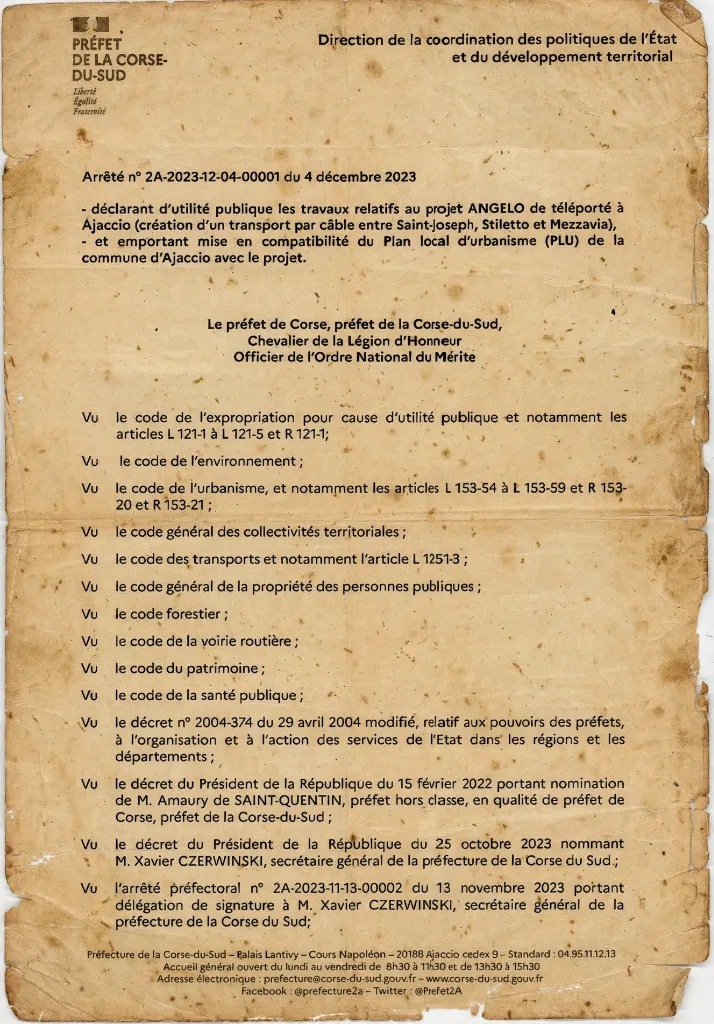
Inaugurated with fanfare in October 2025 to link Saint-Joseph to Mezzavia, the « Angelo » urban cable car represents a total public procurement commitment exceeding €60 million: €38.26 million in construction costs and €23.89 million in operation and maintenance (O&M) over 10 years. Behind the ecological showcase of an aerial ropeway, forensic analysis of the prefectoral DUP order No. 2A-2023-12-04-00001, the official angelo.corsica portal, and the CAPA 2025 Budgetary Orientation Report (ROB) highlights a major economic paradox: an investment 70% funded by central state grants (PTIC) for a piece of infrastructure running a structural operating deficit, whose private annuity is ring-fenced while the historic municipal bus network faces severe cutbacks.
ACT I. THE REAL BUDGET TRAJECTORY : FROM €35M TO €38.26M IN CONSTRUCTION
Scrutiny of official deliberations and contractual documents establishes the actual financial trajectory of the construction procurement:
- 2019 : First initial project estimate announced at approximately €35 million before tax.
- 2022 : Global Design-Build-Operate-Maintain (CREM) contract awarded for an initial construction amount of €34.64 million before tax (approx. €36.01M at initial notifications).
- 2024-2025 : Final execution cost officially established at €38,263,571 following price indexations, updates, and technical amendments (data certified on the official angelo.corsica website and its FAQ).
The Construction Financing Breakdown :
- The Plan de Transformation et d’Investissement pour la Corse (PTIC) : The French central government provided exceptional support covering 70% of the eligible capital expenditure, amounting to roughly €26.7 million.
- European ERDF Funding Application : A European grant of €6.01 million was applied for on an eligible baseline of €34.64M before tax, designed specifically to reduce the direct financial burden on the local metropolitan authority (CAPA).
- Residual CAPA Share : The local authority’s self-financing and loan contribution was calibrated at approximately 30% of initial costs prior to European grant integration.
ACT II. THE POMA OPERATING CONTRACT & THE PROFITABILITY DILEMMA
Beyond the €38.26M construction investment lies the operation and maintenance (O&M) component of the CREM contract:
- The intercommunal authority committed to a 10-year contract totaling €23,892,840 before tax over 10 years (approximately €2.39 million per year).
- This contract was awarded to a dedicated local operating entity whose primary shareholder is ropeway manufacturer POMA, supported for engineering by Egis Rail (75% owned by Caisse des Dépôts, which simultaneously serves as institutional advisor and lender to local authorities).
The Ridership Numbers Paradox :
The public inquiry dossier and inaugural announcements promoted a theoretical financial break-even threshold estimated at ~3,800 trips per day.
However, analysis of operational budget projections exposes a starkly different reality:
- Farebox revenue projections were modeled on a lower baseline of only 3,000 trips per day.
- CAPA’s own institutional FAQ candidly acknowledges the standard rule of public urban transit: ticket sales only cover approximately 20% of operational costs, with the remaining 80% funded directly by the local authority and local taxpayers.
- With actual ridership struggling during the initial operational phases due to fragmented transfers with outlying neighborhoods, the annual operating deficit exceeds €1.9 million, borne by the metropolitan transit budget.
ACT III. ROUTE PROFILE, SITE REALITIES & THE PUBLIC INQUIRY
The aerial alignment spans 2.7 km (frequently rounded to ~3 km depending on station access points), linking Saint-Joseph to Mezzavia via 19 pylons and 4 stations (Saint-Joseph, Stiletto, Mezzavia, and the intermediate Château d’eau station).
On the ground, several engineering challenges and environmental constraints shaped the site:
- Former Saint-Joseph Military Grounds : Hydrocarbon soil contamination pockets from former fuel storage required specialized excavation and foundations anchored by drilled piles.
- Environmental & Topographic Safeguards : Article 5 of the prefectoral DUP order imposed strict mitigation and avoidance protocols for the Hermann’s Tortoise, while tower installations on the steep Sant’Anghjulu ridges necessitated precision helicopter operations.
- Public Utility Easements (SUP) : By decree of December 4, 2023, the Prefecture established overflight easements governing the airspace above private land parcels situated along the cable axis.
- The Public Inquiry Report : Conducted by Mr. Gérard Perfettini between May 30 and June 30, 2023, the inquiry returned a favorable opinion with two formal reservations and three recommendations, insisting that infrastructure success hinges entirely on seamless, cost-free modal interchange with urban bus lines.
ACT IV. THE 2025 CAPA BUDGETARY REPORT (ROB) & THE CONTRAST WITH MUNICIPAL BUSES
The 2025 Budgetary Orientation Report (ROB) of the CAPA highlights the systemic impact of this infrastructure choice across metropolitan mobility policy:
- In a fiscal context where the metropolitan authority emphasizes the absolute need for operational restraint and overhead containment, the Angelo cable car operating budget is ring-fenced from austerity measures.
- The annual operating annuity owed to the private CREM contractor represents a mandatory, incompressible expenditure of nearly €2.4 million per year.
- This contractual obligation directly restricts the operational flexibility allocated to historic public operator SPL Muvitarra, operator of the urban bus network, currently grappling with an aging fleet and sharp labor friction over fleet renewal and operational equilibrium.
📊 FINANCIAL APPENDIX : CERTIFIED BENCHMARK DATA
| Budgetary Item | Certified Amount | Official Source | Financing Key / Finding |
|---|---|---|---|
| Construction Works (Infrastructure & Cabins) | €38,263,571 | Official portal angelo.corsica / DUP | ~70% PTIC (State) + ~30% CAPA (including €6.01M ERDF requested) |
| Operation & Maintenance (O&M - 10 years) | €23,892,840 before tax | CREM Contract / CAPA | Dedicated POMA / Egis Rail entity (~€2.39M/year) |
| Theoretical Break-Even Ridership Stated | ~3,800 trips/day | Public Inquiry Dossier | Initial high-end communication scenario |
| Budgeted Revenue Ridership Baseline | ~3,000 trips/day | Operational Projections | Structural revenue-modeling gap |
| Farebox Operating Cost Recovery Ratio | ~20% | Official angelo.corsica FAQ | Structural operational deficit of ~80% borne by public funds |
Verdict of the L’OCHJU Desk : Official records ground the Angelo cable car in its factual financial reality: a construction investment of €38.26 million (substantially financed by the French State via 70% PTIC grants) coupled with a €23.89 million 10-year operating contract. Yet the core public policy dilemma remains acute: by committing local finances to an inflexible annual operating charge of approximately €2.4 million for an infrastructure that recovers only 20% of its expenses through fares, authorities have secured a ring-fenced private operating annuity at the expense of the historic Muvitarra bus network, whose neighborhood riders now bear the cost in service cuts and reduced frequencies.\n