🔗 MAJOR AJACCIO TRANSIT DOSSIER (PART 2/2) :
This article constitutes the second part of our exclusive investigation on Ajaccio mobility.
👉 Read Part 1/2 : Angelo Cable Car — The 52 M€ Mirage and the POMA Private Annuity
⏱️ THE AUGUST 31 COUNTDOWN : CONTRACT DEADLINE LOOMING :
The Public Service Obligations Contract (COSP) binding CAPA to Muvitarra definitively expires on August 31, 2026. Just 7 days away from this deadline, no new contract has been signed for September 1. This manufactured inertia at executive level creates an alarming contractual void on the eve of the school year: by letting this situation drift without formal commitments, CAPA leadership risks an operational shutdown of the public transit company, opening the path to emergency privatization (DSP).
🏛️ THE MECHANICS OF STRANGULATION : HOW TO DISMANTLE A PUBLIC UTILITY
Throughout the history of public services, the playbook used to justify privatization always follows the exact same 4-step sequence:
- Cut the funding : refuse to repair aging buses and freeze the necessary capital outlays.
- Degrade the service : buses break down, school pupils and workers wait hours at stops, public anger escalates.
- Blame the workforce : publicly claim the problem stems from driver wages or work rules to mask flawed political decisions.
- Unveil the « miracle fix » : announce that a multinational corporation will swoop in to save the network… conveniently omitting that fares will skyrocket.
It is precisely as if the owner of an apartment refused to fix a leaking roof, deliberately allowed the property to deteriorate, and then blamed the tenants for damaging the walls to justify selling the building to a private developer.
Historical amnesia is total: for 15 years (2000-2015), Ajaccio’s bus network (the former TCA) was already contracted out to private operator Transdev. In 2015, CAPA itself decided to oust Transdev to establish public utility SPL Muvitarra, having concluded that private management was costing taxpayers a fortune while leaving vehicles neglected. Turning back the clock today is repeating the exact same blunder made 10 years ago.
Forensic analysis of official tax filings and annual balance sheets cross-referenced with the DREAL Formal Notice proves this strangulation playbook is being methodically executed against SPL Muvitarra.
« Muvitarra is sinking because bus driver wages are 40% above national averages. »
Average wages are €3,350 gross/month (including bonuses and 13th/14th months), strictly matching the French national benchmark (€3,316), while living costs in Corsica are 14% higher.
« The agglomeration pays everything owed and the company alone bears responsibility for its deficit. »
Out of €2.9M in unpaid route fees, CAPA was forced to admit in its crisis statement having made an emergency retroactive settlement of €1.4M and committed €250k/year more.
« The contract is flawlessly managed and buses operate in full statutory compliance. »
Formal Notice issued by DREAL for negative equity (- €766,132) threatening to revoke 38 transport licenses, alongside 11 piecemeal amendments stretching a 3-year contract without inflation adjustments.
« Transit funding goes to neighborhood buses and Angelo costs nothing to the bus network. »
Total debt escalated to €81.95M (ROB 2025), €65.8M invested in transit (including Angelo), and an operating balance subsidy paid by Ajaccio for the Porticcio maritime shuttle outside CAPA territory (ROB 2024, p. 17).
1. CAPA’S UNPAID BALANCES : ADMISSION OF DELAYS & BUDGET STRANGULATION
Operating balance sheets and management audits highlight the structural origin of difficulties: a substantial share of the public transit company’s operating deficit stems from deferred municipal compensations and lagging budget indexation.
While municipal communication frequently pointed toward internal overheads, the urban community mandated vital service extensions for residents without consistently regularizing corresponding funding in a timely manner:
- Service to the New Hospital, Stiletto Middle School & Bodiccione (€278,000/year pending regularization):
To connect the new hospital center and middle school (24 round trips daily), buses traveled 44,133 additional kilometers. The operator requested standard contractual billing to balance accounts. - Reinforcement of Line 4 for Schoolchildren (€390,000/year):
Morning reinforcement runs deployed to transport pupils without delay, remaining long in pending status without formal amendment. - The Fuel Price Surge (€243,000 surcharge at the pump):
When diesel surged by +42%, the absence of an automatic operational indexation mechanism forced the public utility to absorb fuel cost inflation directly from its cash reserves. - Maintenance Equipment Outlays Advanced by the Utility (€351,000):
Heavy maintenance expenditures advanced by the operator on an increasingly aged vehicle fleet.
CAPA’s Official Admission : The Retroactive €1.4 Million Settlement
In its official crisis communiqué released during the labor dispute of December 2025, CAPA formally acknowledged this accumulated liquidity lag, stating verbatim:
« It first carried out a retroactive payment of 1.4 million euros for routes already completed and committed to paying 250,000 euros extra each year to ensure this does not happen again. »
This emergency retroactive payment confirms that financial tensions experienced by the operator stemmed directly from public transport services ordered but delayed in reimbursement.
2. THE DREAL FORMAL NOTICE & THE FINANCIAL WEIGHT OF THE CABLE CAR
The administrative record rests upon a decisive regulatory milestone: the Formal Notice issued by DREAL Corse on December 18, 2023 (Ref: UCS/MO/2023-461).
- Statutory Financial Capacity Requirements:
Noting that equity capital had fallen into negative territory (- €766,132) for the audited financial year, transport oversight authorities cited the legal obligation to maintain a minimum reserve of €195,500 to retain 38 bus operating licenses, setting a compliance deadline. - Contractual Stretching via 11 Piecemeal Amendments:
Lacking a multi-year modernized framework, the contractual relationship was prolonged through 11 successive amendments, maintaining the operator in managerial uncertainty unfavorable to long-term fleet renewals. - The Risk of a Contractual Void at the August 31 Deadline:
With the Public Service Obligations Contract (COSP) expiring on August 31, 2026, the absence of a signed framework contract creates serious legal insecurity for commuters and staff ahead of the new school term. - Budgetary Prioritization of the Angelo Cable Car (ROB 2025 Citations):
In its official Budgetary Orientation Report (ROB 2025, pages 5 and 6), CAPA tallies its transit capital investment program at €65.8 Million (€41.2M net community balance). The report explicitly highlights that operating expenditures are rising due to « commissioning of the cable car and full implementation of amendments with SPL Muvitarra », bringing total community debt to €81.95 Million.
As established in Part 1, the Angelo cable car alone represents €38,263,571 in infrastructure works alongside €23,892,840 excl. tax in 10-year operation and maintenance awarded to the private consortium POMA/Egis, absorbing substantial capital outlays at the expense of upgrading the urban bus fleet.
3. THE BUS FLEET REALITY & LABOR CONDITIONS
To explain transit disruptions, official rhetoric occasionally attempted to attribute responsibility to operating staff. Scrutiny of tax returns and social filings contextualizes the reality:
- The Reality of Mileage Costs (€9 / km):
Community communication argued that operating a bus costs €9/km compared to €4.60 to €6 on the mainland. However, this mechanical overhead arises from island topography, extreme congestion along the Ajaccio bypass (commercial speeds dropping below 11 km/h at peak), and the acute aging of a fleet where 63% of buses are over 10 years old (only 7 new vehicles purchased over 7 years), triggering chronic mechanical failures. - Driver Compensation Levels:
Filed tax returns and social security declarations establish an average gross wage of €3,350 per month (including seniority bonuses and convention 13th/14th months), aligning closely with the French transit sector benchmark (€3,316), while island food and living costs are approximately 14% higher (INSEE data). - Agreement Termination and the 2025 Labor Conflict:
The unilateral termination of company agreements by local authorities in September 2024, coupled with a 15-month negotiating window touching upon sick leave subrogation and acquired leave, generated the breakdown that culminated in the strike of December 2025. - Absenteeism as a Consequence of Strained Working Conditions:
Recorded absenteeism reflects driver exhaustion when confronted daily with failing equipment, spare part shortages, and administrative delays in settling sickness allowance payments.
4. THE MUVIMARE MARITIME DISPARITY (ROB 2024, PAGE 17)
CAPA’s Budgetary Orientation Report (ROB 2024, page 17) records a specific financial mechanism regarding the Muvimare sea shuttle connecting Ajaccio to Porticcio:
- Verbatim Citation from ROB 2024 (Page 17):
CAPA states textually:« Transport levy proceeds cover the public service obligation contract with SPL Muvitarra and its adjustment, and a limited share of the implementation of the sea shuttle between Porticcio and Ajaccio […] requiring an operating balance subsidy from the general budget [of Ajaccio taxpayers]. »
- An Interurban Route Serving an External Municipality:
Porticcio is part of the municipality of Grosseto-Prugna, belonging to the Community of Communes of Pieve de l’Ornano and Taravo (CCPOT), and is not a member of CAPA. - Territorial Allocation Asymmetry:
While local authorities hesitated to safeguard neighborhood feeder routes or the Miséricorde hospital shuttle (€40,000), CAPA’s general budget was called upon to subsidize a trans-gulf maritime link whose primary economic benefits accrue to south shore residential and holiday resort developments.
✊ MASTER PLAN FOR SOVEREIGN MOBILITY IN GREATER AJACCIO (2026-2035)
Confronted with the Angelo illusion and the risk of bus privatization, L’OCHJU rejects fatalism. Our engineering and traffic flow desk modeled a Realistic, Costed, and Concrete Master Plan, calibrated to Ajaccio’s actual geography and the needs of CAPA’s 91,500 residents.
🗺️ SUMMARY OF THE NEW GREATER AJACCIO TRANSIT NETWORK :
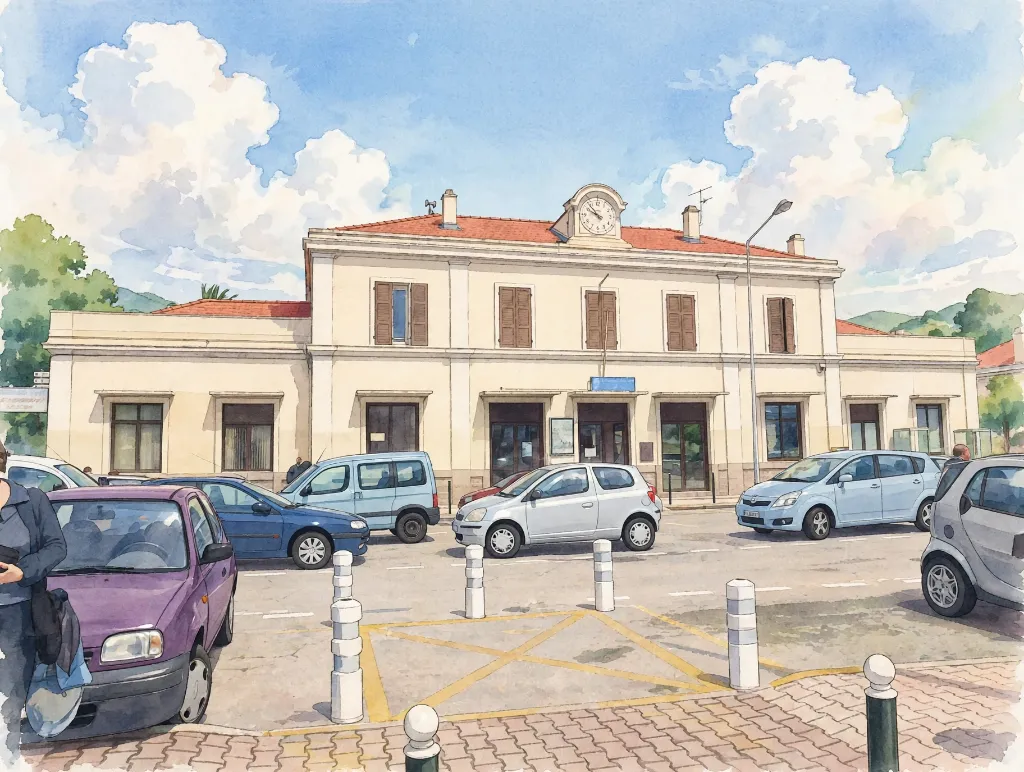
- 🚆 1. The “Ajaccio Regional Express” (CFC Train) : 1 train every 15 min at peak hours between the Mezzana park-and-ride hub and Ajaccio Central Station (14 guaranteed minutes, immune to road gridlock).
- 🚐 2. Connecting the 9 Peripheral CAPA Villages : Regular feeder shuttles from Afa, Alata, Appietto, Cuttoli, Peri, Sarrola, Tavaco, Valle, and Villanova to Mezzana Station and Stiletto Hospital Hub.
- 🚍 3. Pragmatic Rapid Bus Corridors & Priority Traffic Lights : Morning reserved express bus lane on the T21 Penetration Highway (Airport ➔ Station in 10 min), bypass via Eastern Ring Road (D503), and green-wave radio signals on Rocade and Franchini.
- 🅿️ 4. 2 Free Strategic Interception Park-and-Ride Hubs : At Mezzana (1,000 spots) and Ricanto/Campo dell’Oro (600 spots) to halt incoming cars before the city center bottleneck.
- 🏪 5. Historic Town Center Revitalization vs Baléone Sprawl : Direct pedestrian flow from Station and Port docks to Rue Fesch, Place Foch, and Market Square, channeling 15,000 to 20,000 commuters/day to downtown merchants.
📊 DEMOGRAPHIC REALITY & MOBILITY CORRIDORS (INSEE / CAPA FLOW AUDITS)
Corridor T20 / Haute-Gravona & The 9 Suburban Villages
Sarrola, Peri, Cuttoli, Afa, Tavaco, Valle-di-Mezzana...17,700 suburban residents currently 82% captive to private cars. Chronic bottlenecks daily from 7:15 to 9:00 AM from Mezzavia to Baléone.
CFC Regional Express (AMG 800) every 15 min + P+R Mezzana (1,000 spots). Direct journey in 14 guaranteed minutes (saving 30 to 45 min).
Corridor T21 / South Shore & Eastern Districts
Airport, Campo dell'Oro, Vazzio, Aspretto, Porticcio...Severe bottleneck at Ricanto roundabout and continuous gridlock at Aspretto entrance.
T21 Express Bus Lane (7-9 AM) + P+R Ricanto (600 spots). Buses every 6 min reaching Central Station in 10 direct minutes.
Western Basin & Foothills
Alata, Appietto, Villanova, Trova, San Benedetto, Marana...5,750 residents funneling onto D81 road facing Mezzavia choke points to access healthcare or employment.
D81 Express Feeder (every 20 min) directly connecting to Stiletto Healthcare Hub in 8 to 12 min without traversing city center.
Historic Core & Commercial Revitalization
Central Station, Port, Cours Napoléon, Rue Fesch, Place Foch, Market...Downtown retailers suffocated by 4,000 free parking spots at Atrium / Grand Baléone and downtown parking costs.
Direct pedestrian arrival from Station and Port docks 2 min on foot from shops, with unified MUVIPASS and free fares for youth/seniors.
1. Halting the Angelo Annuity & Reclaiming 23.89 Million Euros
- Terminating the under-utilized cable car concession saves the community €2.38 Million annually in private annuities.
- These funds allow immediate complete renewal of the bus fleet (purchasing 66 new low-floor clean-propulsion buses) and restoring robust frequencies across neglected districts (Salines, Cannes, Pietralba, Candia, Finosello, Vazzio, Mezzavia).
2. The “Ajaccio Regional Express” : The Gridlock-Free Heavy Rail Backbone
Along the T20 corridor, 28,000 to 32,000 vehicles queue every morning, causing up to an hour of traffic jams between Mezzavia and downtown. The narrow-gauge metric railway of Chemins de Fer de la Corse (CFC) offers a built, straight 15.2-kilometer line.
- Quarter-Hour (15 min) Peak Headways : Deploying modern AMG 800 trainsets (170 to 340 seats per train), rail provides a carrying capacity of 680 to 1,020 passengers per hour per direction.
- Unbeatable Transit Time : 14 fixed minutes between Mezzana and Ajaccio Central Station, with strategic stops at Salines and Cavone.
- Mezzana Multimodal Hub (1,000 Free Spots) : Located at the junction of the T20 and D161, this secured park-and-ride intercepts commuters from Haute-Gravona, Cruzzini, and central Corsica before congestion points.
3. Connecting the 9 Peripheral Municipalities of Greater Ajaccio
Long marginalized by capital investments concentrated in the urban core, the 17,700 residents of outlying villages gain direct transit links:
- Gravona / Plain Basin (Sarrola-Carcopino 3,350 pop., Peri 2,050 pop., Cuttoli 1,500 pop., Tavaco 420 pop., Valle-di-Mezzana 540 pop.):
Village shuttles synchronized to the minute with train departures at Mezzana. Residents reach the station in under 10 minutes and reach downtown Ajaccio without driving. - Western Basin & Foothills (Alata 3,500 pop., Afa 3,350 pop., Appietto 1,850 pop., Villanova 400 pop.):
Express service via the D81 connecting hamlets (Trova, Pruno, Listincone, Marana) to the Stiletto Healthcare Hub and Mezzavia station every 20 minutes at peak, bypassing road funnels.
4. A Pragmatic Urban Roadmap : Feasible Solutions Without Empty Promises
- Ricanto Penetration Highway (T21) : Reserving the right lane (or widened shoulder) from 7:00 to 9:00 AM for buses and express shuttles, guaranteeing an Airport / South Shore ➔ Downtown transit time of 10 minutes.
- Eastern Ring Road Bypass (D503) : Buses linking Mezzana to the New Ajaccio Hospital (Stiletto) and Vazzio bypass Avenue Noël Franchini completely for a guaranteed travel time of 8 minutes.
- Intelligent Traffic Light Priority : Instead of removing merchant parking along Noël Franchini, installing radio transponders that automatically trigger green lights as Muvistrada buses approach.
5. Revitalizing the Historic Core Against Baléone Retail Sprawl
Giant shopping complexes on the urban fringe have drained commercial vitality from the historic center. Revitalization requires reclaiming access:
- Direct Passenger Arrival at Merchant Doorsteps : Passengers arriving via train and sea shuttles disembark onto the Central Station and Port docks, 2 minutes on foot from Rue Fesch, Place Foch, and Market Square.
- The Unified MUVIPASS : A single contactless card or smartphone app granting integrated access to buses, CFC trains, Muvimare ferries, and park-and-ride hubs.
- Targeted Citizen Free Transit : 100% free fares for schoolchildren, students, and resident retirees, funded by an equitable contribution levied on summer tourist rental vehicles.
L'OCHJU is the gaze that will no longer look away.
— L'OCHJU Investigation Desk