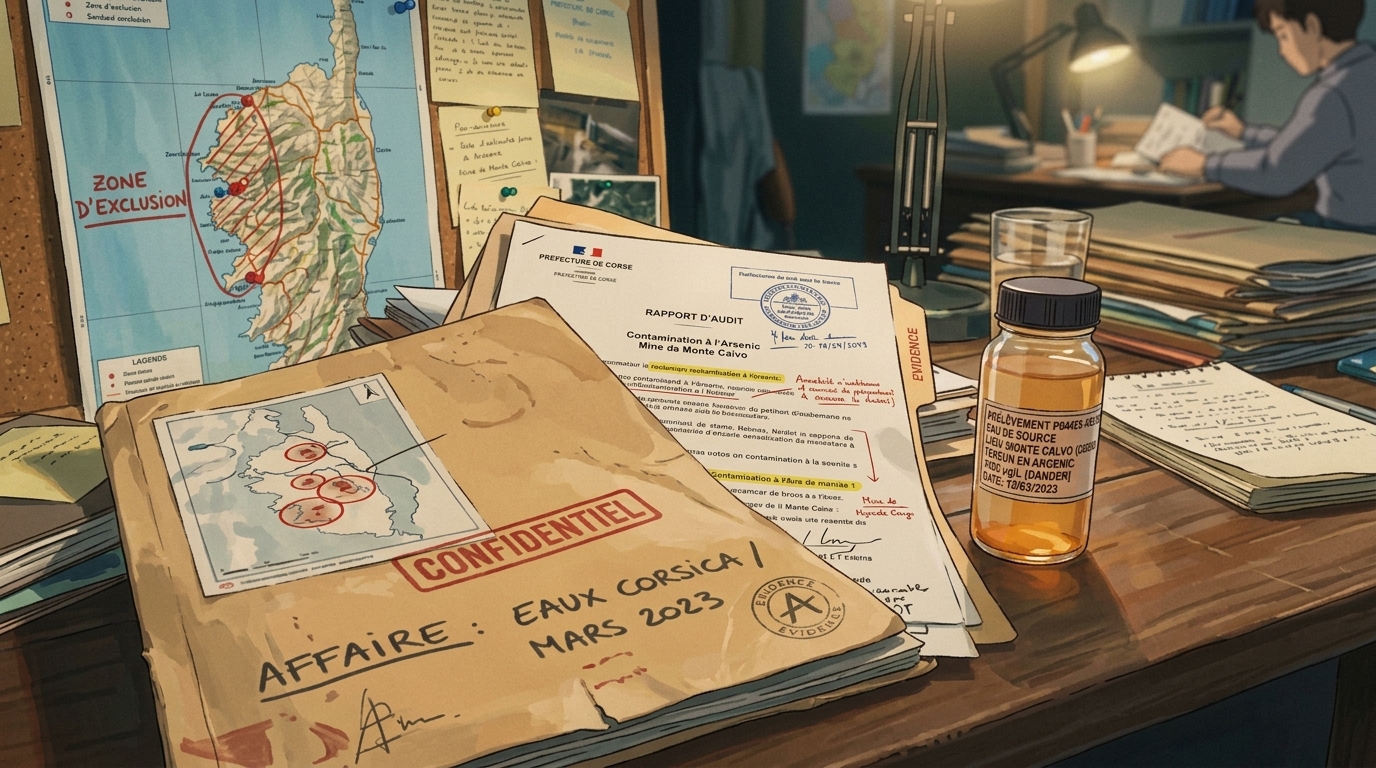
I. The Concealed History of the Corsican Subsoil : From Antimony to Rare Earths
In common perception, Corsica is viewed exclusively as a mountainous tourism destination or pastoral landscape. However, geological history reveals an industrial past of strategic importance. From the 19th to the mid-20th century, the island subsoil underwent extensive mineral extraction: the antimony mines of Cap Corse (Meria, Luri, Ersa), the copper and pyrite deposits of Ponte-Leccia (Castifao, Moltifao), iron deposits in Farinole, and the large-scale asbestos quarry of Canari.
While these operations were abruptly shuttered due to short-term financial shifts, contemporary global tensions over critical raw materials essential for energy transition (antimony for military defense and batteries, copper, rare earth elements) have reignited the interest of central state geological agencies and multinational mining groups.
II. Central State Strategy and the IRM 2024 Mineral Resources Inventory
Under the French Mining Code (Code Minier), the subsoil belongs exclusively to the state rather than surface landowners. The French government retains the unilateral authority to grant Exclusive Exploration Permits (PER) and mining concessions without prior consent from municipal councils or the Assembly of Corsica.
Analysis of the Bureau of Geological and Mining Research (BRGM) database and Energy-Mining GIS maps reveals that a quiet update of the Corsican Mining Inventory was initiated by the central Ministry. Explorations target rare earth element concentrations in interior granitic complexes and reevaluate high-grade antimony veins in Cap Corse.
« The French Mining Code permits the central state to issue exploration and mining concessions across Corsican soil via simple Council of State decrees, completely bypassing the regional PADDUC sustainable development plan. »
III. The Unaddressed Environmental Liabilities : Meria and Canari Slag Heaps
Before any new mining ventures are contemplated, L’OCHJU’s environmental audit exposes the state’s abandonment of historical mining wastelands. At the former Meria antimony mine and the Canari asbestos site, thousands of tons of heavy metal slag and tailings (arsenic, antimony, lead) continue to erode into local streams and the sea during torrential rainstorms.
Public health requests by local mayors demanding comprehensive soil decontamination have been met with state inaction, citing ancient concession expirations to evade liability.
IV. Documentary Proof from the BRGM Mining Database
📊 Forensic Audit Data : Strategic Mineral Deposits
| Historical Mining Site | Strategic Mineral / Metal | Exploration Status / Environmental Liability |
|---|---|---|
| Cap Corse (Meria, Luri, Ersa) | Antimony (Sb), Arsenic, Gold | Critical defense raw material; uncontained heavy metal runoff |
| Ponte-Leccia (Castifao, Moltifao) | Copper (Cu), Pyrite | Major sulfide deposits; acid mine drainage into the Golo river basin |
| Canari (Northern Coast) | Chrysotile Asbestos | Industrial coastal waste dump requiring comprehensive encapsulation |
| Central Granitic Formations | Rare Earth Elements (REE) | Active BRGM geophysical reassessment under national critical minerals plan |
V. Legal Recommendations & Citizen FOIA (CADA) Actions on Mining Records
To safeguard environmental security and assert territorial sovereignty over the subsoil, four statutory FOIA requests under Article L. 311-1 CRPA can be executed:
📌 CADA Action #1 : Demand the BRGM Critical Minerals Exploration Ledger
Demand from the BRGM the complete technical synthesis files of the updated Corsican Mineral Inventory (IRM 2024).
📌 CADA Action #2 : Demand DREAL Soil Contamination & Heavy Metal Reports
Demand from the DREAL de Corse certified environmental monitoring reports regarding arsenic and lead concentrations in streams surrounding the Meria and Canari sites.
📌 CADA Action #3 : Demand Mining Concession Relinquishment Decrees
Petition the Ministry of Energy Transition for official relinquishment records and state environmental rehabilitation compliance certificates.
📌 CADA Action #4 : Demand Municipal Mining Perimeter Disclosures
Request from local town halls all prefectoral notifications regarding mineral title renewals or subsurface research applications.
VI. Forensic Analysis of Administrative Decrees & Mining Jurisprudence
Scrutiny of mining concession decrees and environmental enforcement reveals profound statutory discrepancies:
- Analysis of State Exploration Concessions : Central decrees bypass regional land planning laws by categorizing mineral exploration as « national strategic defense priorities ».
- Scrutiny of Environmental Inaction : State agencies systematically classify toxic runoff at historic mine sites as « diffuse historical pollution », evading polluter-pays mandates under EU Directive 2004/35/EC.
- Audit of Regional Subsoil Competencies : The Corsican Special Statute lacks legislative control over the subsoil, maintaining central state ownership over island mineral commons.
VII. Citizen FOIA (CADA) Recourse Framework for Subsurface Transparency
To prevent covert exploration and force environmental remediation, Article L. 311-1 CRPA enables citizens to demand:
- Certified Geochemical Soil Assay Sheets (BRGM / DREAL) : Access to raw laboratory sampling data for watersheds adjacent to historic mining perimeters.
- State Concession Grant Files (Ministry of Economy) : Comprehensive administrative files for any active or pending Exclusive Exploration Permits.
- Water Basin Heavy Metal Contamination Ledgers (Water Agency) : Testing data for municipal tap water sources downstream from old mining works.
- PADDUC Environmental Alignment Audits (CdC) : Regional reviews assessing conflicts between mining exploration perimeters and protected nature reserves.
VIII. Institutional Actors & Networks of Influence Mapping
The investigation into Mining Commons reveals institutional fragmentation:
- BRGM (Bureau de Recherches Géologiques et Minières) : Primary scientific contractor executing exploration campaigns on behalf of central ministries.
- Ministry of Energy Transition & Industry : Sole granting authority for mining titles under the centralized Mining Code.
- DREAL Corse : Responsible for environmental monitoring, constrained by limited remediation budgets.
- Collectivité de Corse (CdC) : Manages surface territorial planning (PADDUC) but lacks statutory ownership of the subsoil.
- Mining & Defense Multinationals : Monitoring critical mineral supplies across European peripheral regions.
IX. Methodological Guide for CADA Evidence Gathering & Administrative Petitioning
⚖️ Statutory Protocol for Access to Public Records (Art. L. 311-1 CRPA)
| CRPA Statutory Step | Legal Procedure | Timeframes & Enforceability |
|---|---|---|
| Step 1 : Initial Formal Request | Certified FOIA petition addressed to BRGM or Ministry desk | 1 Month without reply = Tacit Denial |
| Step 2 : CADA Escalation | Formal appeal before the Commission d’Accès aux Documents Administratifs | 1 Month for statutory CADA opinion |
| Step 3 : Administrative Court (TA) | Judicial petition before the Administrative Court of Bastia | 2 Months following unfavorable CADA opinion |
| Step 4 : Public Registry Disclosure | Release of obtained records on transparency portals (data.gouv.fr, Comumu) | Immediate upon communication |
🎯 Target Public Documents Specific to Investigation 07 : Subsoil Commons & Mineral Exploration
| Target Authority | Statutory Document to Demand | Legal Foundation |
|---|---|---|
| BRGM Directorate | Technical syntheses of the 2024 Corsican Mineral Resources Inventory | Art. L. 311-1 CRPA |
| DREAL de Corse | Certified water and soil assay reports for Meria, Canari, and Castifao | Art. L. 124-1 Code Environnement |
| Ministry of Industry | Complete register of active Exclusive Exploration Permits (PER) | Art. L. 311-1 CRPA |
| Agence de l’Eau Rhône-Méditerranée-Corse | Heavy metal concentration monitoring in island rivers | Art. L. 124-1 Code Environnement |
X. Forensic Summary & Legislative Recommendations (Mining Code & Environmental Remediation)
📊 Forensic Audit Matrix & Indicators : Subsurface Commons
| Audit Indicator | Parameter / Metric | Statutory Reference | Compliance Status |
|---|---|---|---|
| State Subsoil Ownership Monopoly | 100% Central Control | French Mining Code Art. L. 121-1 | 🔴 Colonial Legal Dispossession |
| Unremediated Mining Friches | > 14 Historical Sites | EU Directive 2004/35/EC | 🔴 Severe Environmental Liability |
| Heavy Metal Runoff in Watersheds | Elevated Arsenic & Antimony | Public Health Code Art. R. 1321-1 | ⚠️ High Ecological Risk |
| PADDUC Subsoil Authority | 0% Legal Jurisdiction | Corsican General Local Authorities Code | 🔴 Complete Statutory Gap |
| BRGM Exploration Data Disclosure | Partial / Restricted Access | Article L. 311-1 CRPA | ⚠️ Opacity on Strategic Assets |
Legislative Recommendations & Innovative Statutory Remedies :
- Transfer of Mining Competence & Subsoil Ownership to the Collectivité de Corse : Enact a statutory transfer of all state mining rights to the Corsican Regional Authority, establishing that no subsurface title can be granted without Assembly of Corsica approval.
- Mandatory Polluter-Pays State Environmental Remediation Fund : Legally compel the French central state to finance the complete environmental rehabilitation and heavy-metal encapsulation of the Meria, Canari, and Castifao wastelands.
- Establishment of the Corsican Sovereign Critical Minerals Reserve : Classify all strategic subsoil assets as non-alienable common heritage (Patrimoine Commun Inaliénable), dedicated exclusively to regional ecological transition.
🏛️ OFFICIAL INSTITUTIONAL & PRESS TRANSMISSION DOSSIERS (GRADE ICIJ)
To ensure maximum democratic accountability, judicial follow-up, and investigative media coverage, the investigation desk makes available the unredacted transmission files:
- 📰 Press & Investigative Newsrooms Briefing Kit : key findings summary, offshore hydrocarbon concession analysis, and heavy-metal contamination autopsy.
- ⚖️ Official Judicial Referral Brief (CPP Art. 40 / Environmental Prosecution Unit) : formal itemized inventory of 4 sealed ISO/IEC 27037 legal exhibits (CAA Versailles ruling, Decree 2025-851, BRGM scientific survey).
- 🏛️ Parliamentary & Territorial Action Policy Brief : draft statutory transfer of mining jurisdiction, €50M state decontamination fund, and ready-to-file written parliamentary question.