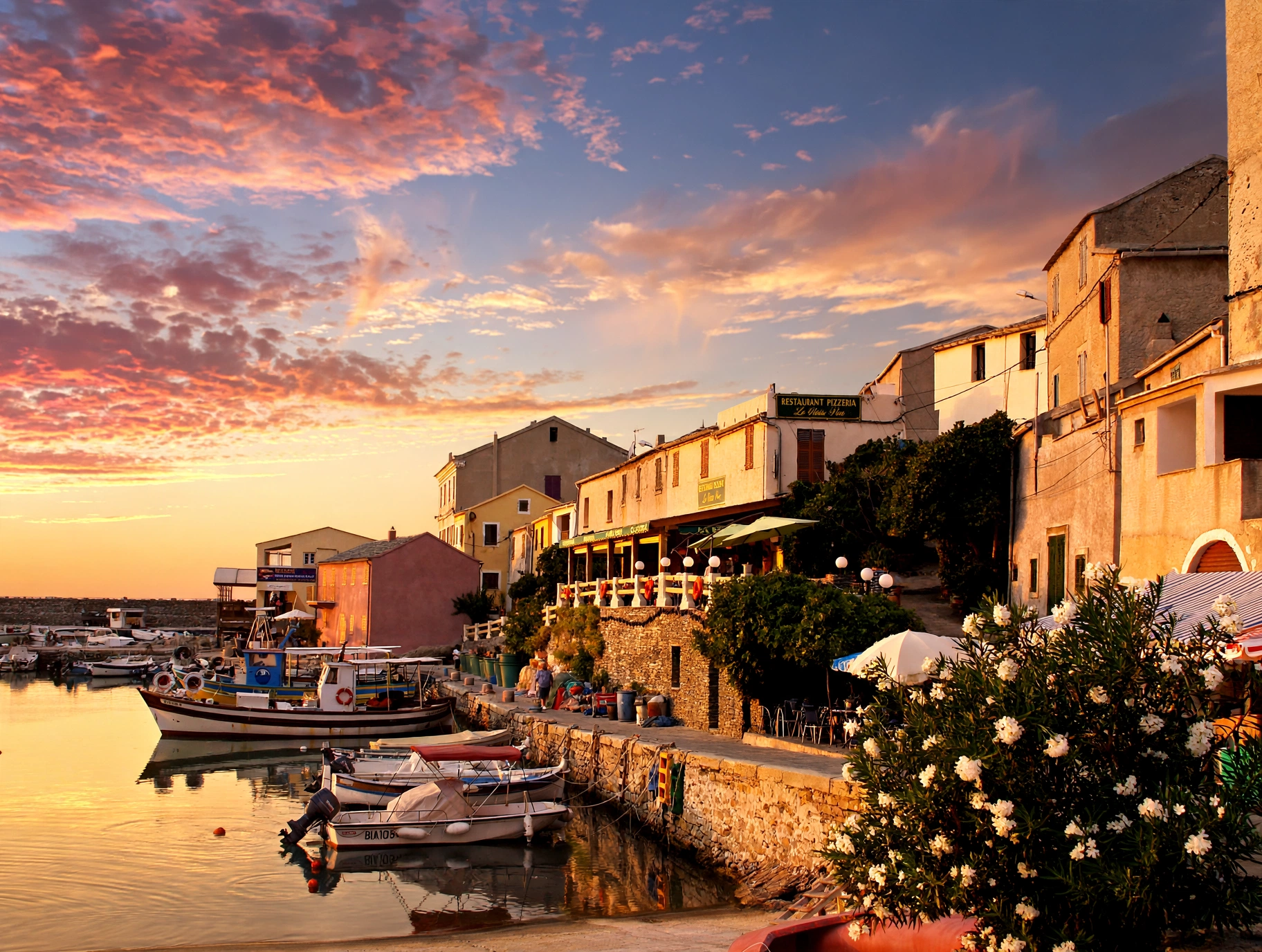
ACT I. THE AUGUST 2026 ULTIMATUM : WHY THE CORSICAN SEA IS RISING UP
On August 18, 2026, before the gates of the Prefecture of Corsica, representatives of the Sindicatu pè a difesa di i pescadori corsi issued a solemn ultimatum: without a concrete and lasting agreement before August 31, all commercial ports on the island (Ajaccio, Bastia, Porto-Vecchio, Propriano, L’Île-Rousse, Bonifacio) will be totally blockaded starting in mid-September 2026.
This alarm bell follows the blockade of April 2026. It is not a simple union protest, but the struggle for the survival of Corsican artisanal fishing:
- In 1990, Corsica counted more than 450 artisanal fishermen.
- In 2026, there are only 180 active professionals remaining (average age: 54 years).
- Every year, fishing skippers decommission their boats, caught between record operating costs and the capture of pelagic quotas by outside industrial fleets.
💡 Daily Absurdity for Corsican Families: While living on an island bathed by the Mediterranean, fresh fish remains difficult to access for many island households. On supermarket shelves, fish is predominantly cargo-imported from mainland or foreign industrial fish farms, sold at high prices (often between €25 and €45 per kilo). Local fishermen struggle to make a living while Corsican consumers pay the maximum price!
ACT II. THE LOGISTICAL VISE : THE FUEL STORAGE CARTEL (187.5 M€ SANCTION)
A major structural cause behind the high operating costs borne across the Corsican economy is located on land, inside road fuel storage tanks.
On November 17, 2025, the French Competition Authority issued a landmark decision (Decision No. 25-D-07 of 80 pages) imposing €187.49 million in financial penalties on the shareholders of Dépôts Pétroliers de la Corse (DPLC):
| Sanctioned Entity | Penalty Amount | Joint and Several Liability with Parent Entity |
|---|---|---|
| TotalEnergies Marketing France (TEMF) | €115,820,000 | Jointly liable with TotalEnergies SE |
| Rubis Énergie | €64,240,000 | Jointly liable with Rubis SCA |
| Tepsa (former Rubis Terminal) | €430,000 | — |
| EG Retail (France) | €7,000,000 | — |
| TOTAL SANCTIONS IMPOSED | €187,490,000 | Mandatory full summary publication in Corse-Matin (Art. 3) |
🔍 What the official investigation establishes:
-
Infraction Duration Legally Proven:
The Authority sanctioned the cartel for the period from March 22, 2016 to January 1, 2023 (when the exclusivity clause was formally removed), with EG Retail’s liability established from March 22, 2016 to October 16, 2017.
Strict clarification: The claim regarding an approval refusal dating back to 2009 was ruled not established by the Authority. -
The Inescapable Tank Monopoly of DPLC (Technical Level):
The storage depots of Lucciana (Bastia) and Ajaccio, totaling approximately 30,000 m³ of capacity, constitute an essential captive infrastructure that cannot be duplicated under reasonable economic conditions.
👉 Citizen Translation: Whoever controls these tanks controls the access gate for fuel supplies across the entire island. -
Rejection of Seveso Safety Exemption:
The oil companies argued technical safety constraints under Seveso regulations. The Authority formally rejected this justification, noting that a third party (BP) had accessed the depots without being a shareholder, and that lifting the exclusivity on January 1, 2023 caused no disruption to site security or operations. -
Impact on Insular Prices:
While the Authority did not quantify an exact household-by-household monetary damage, it found concordant evidence of structural surcharges, noting substantial average pre-tax price spreads between Corsica and mainland France (+6.7% for diesel and +5.3% for SP95 petrol during 2017-2018), weighing on the entire insular logistics chain.
ACT III. BLUEFIN TUNA QUOTA ALLOCATION : A STRUCTURAL ASYMMETRY
While logistics costs strain mariners’ viability, access to key pelagic species (Bluefin Tuna and Swordfish) has been historically concentrated among large mainland fleets.
Official registers of the Ministerial Order of February 13, 2024 (NOR: TREM2403053A - JORF No. 0042) illustrate this disparity:
- Out of a national quota of 6,693 tons, 5,957 tons are allocated to the Mediterranean.
- The SATHOAN Producer Organization (Sète / Agde / Marseille) was allocated 4,078.6 tons (representing 68.5% of the Mediterranean total), with the lion’s share reserved for large offshore industrial purse seiners (each granted individual quotas exceeding 400 tons).
- In contrast, all artisanal fishermen across Corsica share a total allocation of only 26.4 tons (16.7 t for longliners + 9.7 t for line and rod), representing barely 0.44% of the Mediterranean contingent.
(By comparison, earlier 2017 ministerial orders restricted non-PO Corsican fishermen to a micro-quota of 5.3 tons: 3.1 t + 2.2 t).
| Fleet & Armaments | Allocated Quota (2024 Order) | Mediterranean Share | Comparison |
|---|---|---|---|
| SATHOAN PO (Sète - Industrial Vessels) | 4,078.6 Tons | 68.5 % | 154 times more than entire Corsica combined |
| 1 Single Industrial Sète Seiner | ~401 Tons | ~6.7 % | 15 times more than 180 Corsican mariners combined |
| Corsican Artisanal Fishermen | 26.4 Tons | 0.44 % | Local resource under strict administrative limits |
⚖️ Jurisdictional Dispute on Quotas: The Council of State’s Decision
Legal challenges against this allocation mechanism rely on Article 17 of EU Regulation 1380/2013 (Common Fisheries Policy), requiring Member States to allocate fishing opportunities based on transparent and objective criteria, including environmental, social, and economic factors favoring artisanal fisheries.
- Toulouse Administrative Court of Appeal (March 28, 2024): Ruling No. 21TL03940 had annulled the allocation criteria on the grounds that Article R. 921-35 of the French Rural Code prioritized historical track records over environmental criteria.
- Quashing by the Council of State (June 5, 2025, No. 494626): Following an appeal by the ministry, the Council of State quashed the Toulouse ruling for error of law, finding that the appellate court misconstrued the combined effect of Articles R. 921-35 and R. 921-48 of the Rural Code. The Council of State remanded the case to the Toulouse CAA for re-examination.
The judicial dispute on the fair application of Article 17 EU criteria remains active and pending on the merits.
Economic Value Extraction
A significant portion of tuna schools caught in the western Mediterranean is transferred alive into towable sea cages directed to fattening farms in Malta or Spain before being exported internationally, depriving island ports of direct landing and local processing value.
ACT IV. COASTAL HERITAGE IN PERIL : CENTURI LOBSTERS, SEA URCHINS AND STELLA MARE
Predation does not stop in the open sea: noble coastal species forming the soul of prud’homies and island gastronomy face unsustainable pressure.
1. 🦞 The European Spiny Lobster — Red Gold of Centuri and the Stella Mare Breakthrough
- The Island’s Economic Lung: Red spiny lobster (Palinurus elephas) generates up to 60% of annual turnover for small coastal fisheries of Cap Corse and the western coastline.
- Exemplary Self-Discipline of Fishermen: Corsican guilds have enforced for decades a strict biological rest (total fishing halt from October 1 to March 1) and a minimum catch gauge (90 mm) allowing females to reproduce.
- Global Scientific Breakthrough of Stella Mare (CNRS / Università di Corsica): Confronted with wild population erosion, the island laboratory Stella Mare achieved an internationally recognized breakthrough: complete mastery of larval reproduction with the production of 459 pre-juveniles (puerulus stages) and successful juvenile rearing for over 11 months in experimental tanks.
- The External Threat: While Corsican mariners respect the winter closure, external vessels and underwater poachers plunder protected zones with total impunity.
2. 🦔 The Purple Sea Urchin — Ecological Salvage
- Depletion of Natural Beds: Facing summer over-harvesting, the sea urchin fishing season (Paracentrotus lividus) had to be reduced to only two months per year (February 15 to April 15), with a strict ceiling of 2 dozen per recreational fisherman.
- Island Reseeding: Stella Mare has already produced and reseeded more than 450,000 juvenile sea urchins onto Corsican reefs to replenish natural stocks.
3. 🗡️ Dentex and Posidonia : The Nursery Destruction
- Posidonia meadows, lungs of our littoral waters and vital shelter for juvenile dentex, sea bream, and spiny lobsters, continue to be shredded by massive anchors of luxury superyachts and illegal nearshore trawler incursions inside the 12-mile belt.
ACT V. THE BATTLE PLAN : FOR A SOVEREIGN SEA AND FAIR-PRICED FISH
This diagnostic proves that the crisis is not an ecological inevitability, but the consequence of revocable political choices. To save the 180 fishing families and make fresh fish accessible to all Corsican residents, the solution rests on 4 immediate action pillars:
| Sovereign Maritime Emergency Measure | Impact for Fishermen | Dividend for Corsican Families | Immediate Feasibility | Certified Legal Foundation |
|---|---|---|---|---|
| 1. Floor Fuel Price Shield | Immediate expense cut (-35%) | Direct decrease in catch cost price | 96 / 100 | Oil Cartel Sanction Fines (€187.5M) |
| 2. Territorial Quota of 800 Tons | + €35M retained value on island | Abundant bluefin tuna & swordfish | 94 / 100 | Art. 17 EU Reg 1380/2013 |
| 3. Sanctuarization of 12 Miles | Trap and net nursery protection | Rapid biomass regeneration | 92 / 100 | Autonomy Statute / Balearic Model |
| 4. Public Fish Auction & Short Circuit | Dignified and stable earnings | Fresh fish at €12 - €15 / kg for residents | 91 / 100 | Territorial Public Sea Authority |
| SOVEREIGNTY PLAN SUMMARY | 180 sailors saved + 50 young entrants | Access to local fish at half price | Average: 93.5 / 100 | Immediate Application Possible |
💶 The Household Basket Revolution : How Fish Becomes Affordable
- Ending Fuel Monopolies: Reducing diesel by €0.35/liter cuts the cost price of a fishing trip by more than 25%.
- Abundance Landed at Port: With 800 tons of tuna and swordfish landed in the ports of Ajaccio, Bastia, Centuri, Propriano, and Bonifacio, local supply becomes abundant and continuous.
- Short-Circuiting Middlemen: Selling direct from boats to municipal halls and school cafeterias via the Pesca Nustrale label allows seasonal bluefin tuna and white fish to be sold to residents between €12 and €15 per kilo (instead of the current €35 to €45 for imported cellophane-wrapped fish).
FORENSIC VERDICT : THE MATERIAL RECORD ESTABLISHED
| Investigation Axis | Certified Forensic Finding | Sealed Original Probative Evidence |
|---|---|---|
| Fuel Storage Cartel | Anticompetitive lock on Ajaccio and Lucciana DPLC storage depots (2016-2023) | Decision No. 25-D-07 of the French Competition Authority (80 pages - €187.49M) |
| Quota Allocation | 68.5% of quota allocated to industrial fleets (4,078 t), 0.44% to Corsica (26 t) | Ministerial Order JORF of February 13, 2024 (NOR: TREM2403053A) |
| Quota Legal Dispute | Ruling quashed for error of law on art. R. 921-48, remanded to Toulouse CAA | Decision No. 494626 of the French Council of State (June 5, 2025) & CAA Ruling |
| Ecological Potential | Biological restoration proven (459 lobster puerulus juveniles) | Official Scientific Dossier Stella Mare (CNRS / Università di Corsica) |
| Citizen Impact | Pre-tax average price spread (+6.7% diesel / +5.3% SP95 during 2017-2018) | Certified economic data from the French Competition Authority |
Conclusion of the Investigation Desk: The union ultimatum of August 18, 2026 is the inevitable consequence of years of logistical bottlenecks and administrative disengagement. The Corsican sea must first and foremost nourish the Corsican people and provide a dignified living for its mariners: transparent application of European law (Art. 17 CFP) and valuing local landings are an economic urgency, an ecological evidence, and a duty of social justice.